Nursing school GPA requirements: what ABSN programs ask for
In this article8 sections

Most accelerated Bachelor of Science in Nursing (ABSN) programs ask for a minimum grade point average (GPA) of 3.0. Of the 253 programs that publish a minimum, 144 set it at 3.0, while 96 accept less: 76 take 2.75 or lower, and 32 take 2.5 or lower. A minimum is the floor to apply, though, not the GPA that gets you in.
These numbers come from ABSNcheck's directory of 314 ABSN programs, each checked against the school's own pages in November 2026. Here is what nursing schools ask for, which GPA they actually look at, and what to do if yours is low.
What GPA do you need for nursing school?
For an ABSN, plan on a 3.0. It is the most common minimum by far, and some programs that accept less say stronger applicants come in higher. A few programs go above 3.0. Westmont College sets the highest bar we found: a 3.40 cumulative GPA and a 3.30 science GPA.
A handful publish no minimum at all, but still name a target. Drake University requires no minimum, "although 3.0 (as calculated in NursingCAS) is considered competitive."
ABSN GPA requirements by the numbers
| Minimum overall GPA | Programs |
|---|---|
| 2.0 to 2.49 | 3 |
| 2.5 | 29 |
| 2.6 to 2.75 | 44 |
| 2.8 to 2.99 | 20 |
| 3.0 | 144 |
| Above 3.0 | 13 |
Minimum cumulative GPA as published by 253 ABSN programs, November 2026. Another 61 programs we track publish no numeric minimum.
Only two programs accept a 2.0: Baker College and Denver College of Nursing. To see every program and its requirements, browse the ABSN directory.
Science GPA requirements
Many programs look at your science grades separately. Of the 68 programs that publish a minimum science GPA, 35 set it at 3.0, 28 accept less, and 5 ask for more.
Each school decides which courses count. Florida Atlantic University, for example, figures its 3.0 science GPA from Anatomy & Physiology I and II, Microbiology, and Chemistry, each with a lab, plus College Algebra and Statistics.
Which GPA counts
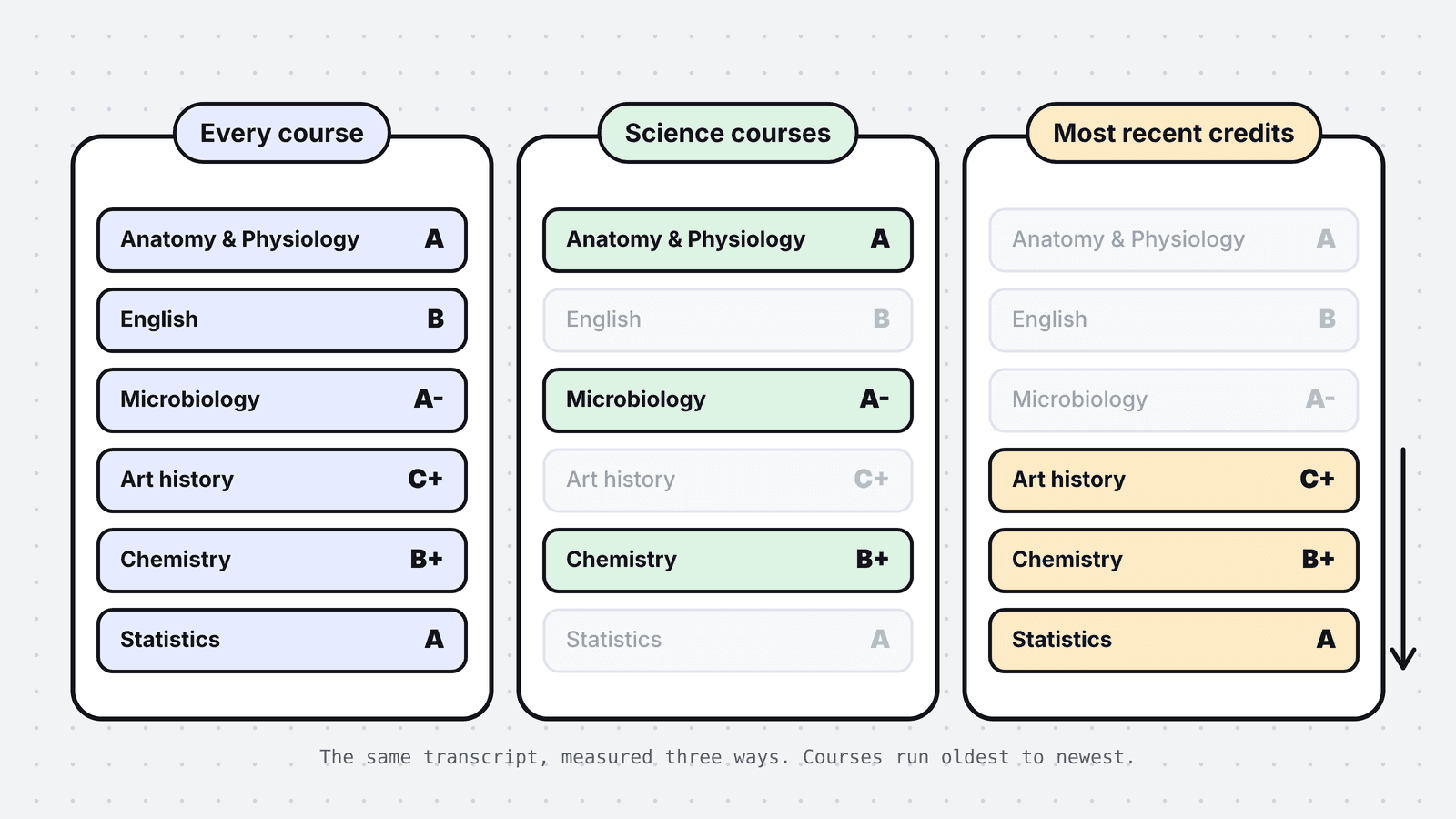
"GPA" can mean different numbers at different schools, and the difference can work in your favor:
- Your whole record. Most programs use your cumulative GPA across all college work.
- Your most recent credits. Some count only your latest coursework. Cal State Fullerton requires a 3.25 in your most recent 60 semester units, and the University of Mobile requires a 3.0 on your last 60 hours.
- Your prerequisites. Others focus on the courses the program requires. The University of South Florida lists an "Overall Minimum Nursing Prerequisite GPA: 3.0."
- A sliding scale. Herzing University accepts a 2.50 GPA if you also score 66 on the Test of Essential Academic Skills (TEAS) entrance exam. From 3.00 to 3.49 it asks for a 3.00 science GPA instead, and from 3.50 up, nothing more.
Retaken courses are counted differently, too. For its prerequisite GPA, the University at Buffalo uses your highest grade, while Indiana State University counts every attempt from the last ten years. If you apply through NursingCAS, the shared nursing application, "all grades earned for repeated courses are factored into your NursingCAS School GPA." See which programs use NursingCAS.
Minimum GPA vs. a competitive GPA
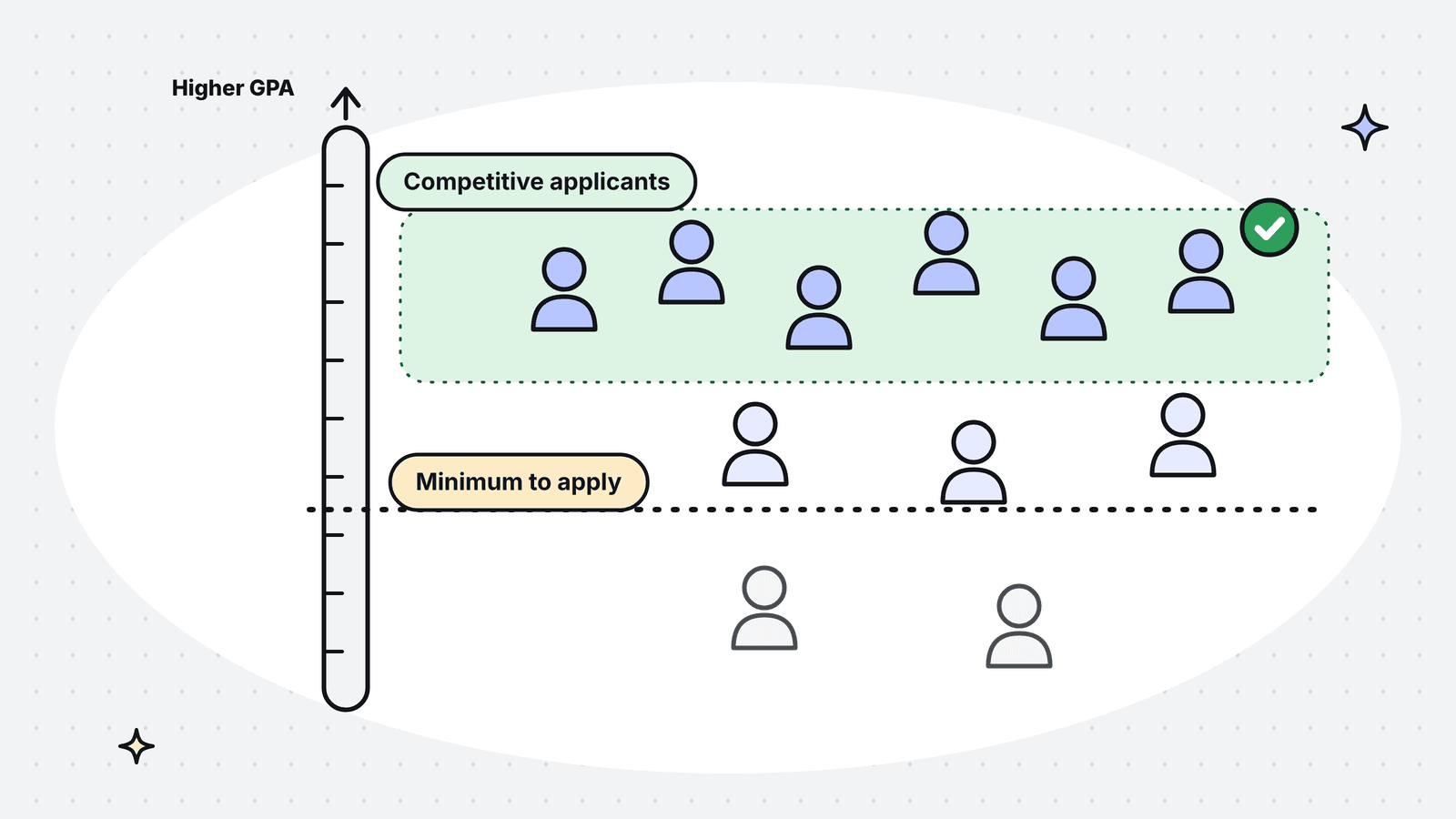
Meeting the minimum means a program will review your application. It doesn't mean you'll be admitted. Baker College asks for a 2.0, "though competitive applicants often have higher GPAs." Rutgers University-Camden reviews every application, but says "applicants with GPAs of at least 3.0 are more competitive."
Few programs we track publish the average GPA of the students they admit, so ask the admissions office if it matters to you.
How to get into nursing school with a low GPA
A GPA below 3.0 narrows your options, but it doesn't close them:
- Look for programs that count recent work. If your grades improved, a program that uses your last 60 credits sees your better years.
- Make your prerequisites count. Strong grades in Anatomy & Physiology, Microbiology, and Chemistry help at programs that use a prerequisite or science GPA. See our nursing prerequisites guide.
- Check retake rules before you retake. A new A replaces a C at some schools and is averaged in at others.
- Lean on your entrance exam. Some programs, like Herzing, let a strong TEAS score offset a lower GPA.
- Apply widely. With 96 programs setting a minimum below 3.0, a 2.5 to 2.9 GPA still leaves real choices.
Check your GPA against each program
GPA is one requirement. Courses, grades, time limits, and exams all have to line up too. ABSNcheck compares your GPA, courses, and exams with each program's published requirements, with a link to the page each requirement came from. Typing in your courses is free, and so is the result for one program.
Frequently asked questions
What GPA do you need to get into nursing school?
Most ABSN programs require at least a 3.0 GPA. Ninety-six of the 253 programs that publish a minimum accept less, some as low as 2.5 or 2.0.
Can you get into nursing school with a 2.5 GPA?
Yes, at some programs. Of the 253 ABSN programs that publish a minimum GPA, 32 accept 2.5 or lower. Strong prerequisite grades and entrance exam scores help.
Do nursing schools look at science GPA?
Many do. Sixty-eight ABSN programs publish a separate minimum science GPA, most often 3.0, and each school decides which courses count toward it.
Do nursing schools count retaken classes?
It depends on the school. Some use your highest grade, others average every attempt. NursingCAS factors all grades from repeated courses into its GPA.
What is a competitive GPA for an ABSN?
Usually 3.0 or higher. Several programs with lower minimums say competitive applicants have higher GPAs, so ask each school what its admitted students average.