How much does an ABSN cost? Tuition at 133 programs
In this article9 sections
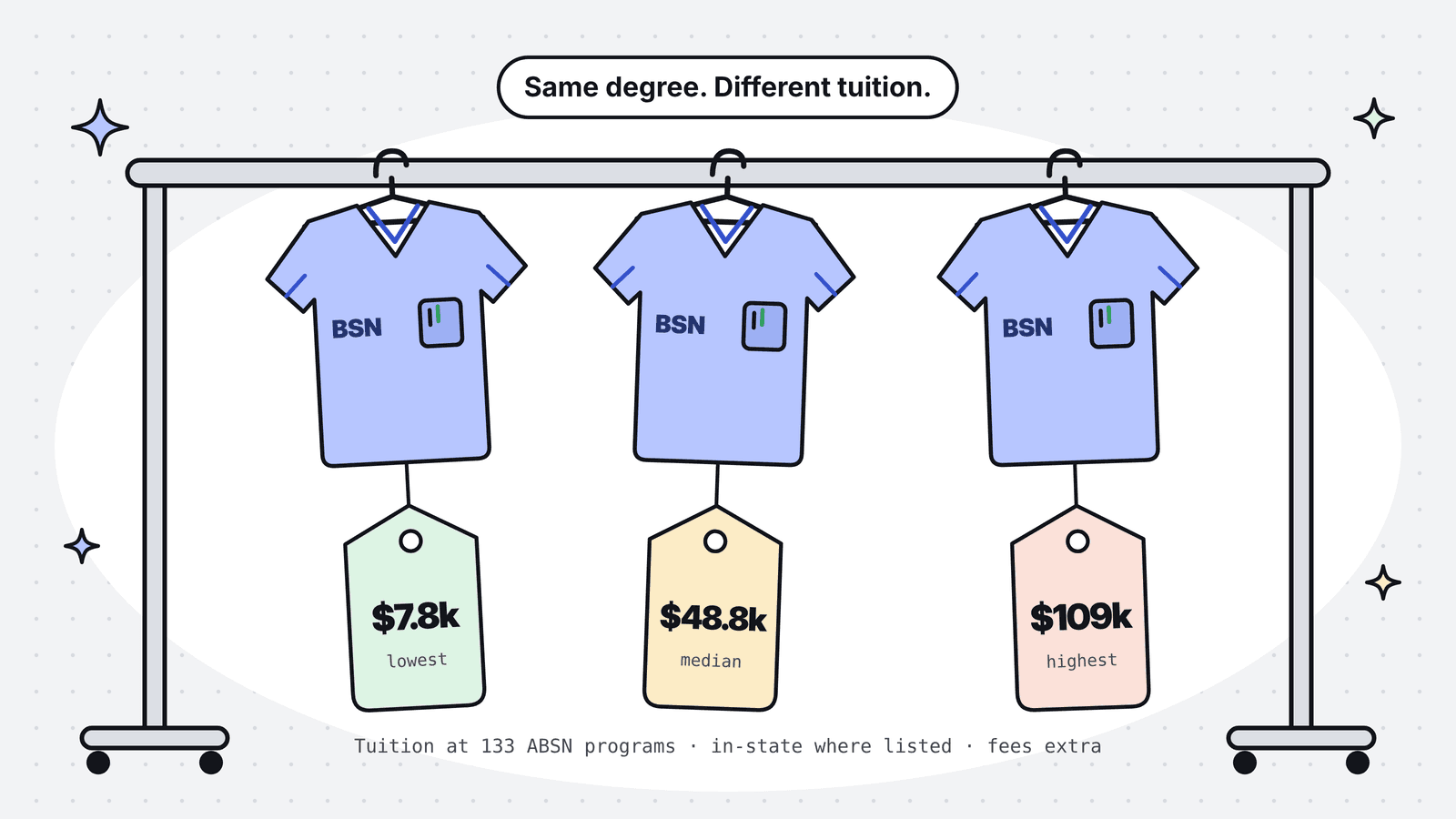
An accelerated Bachelor of Science in Nursing (ABSN) typically costs about $37,500 to $59,100 in tuition. Across 133 programs where we could work out tuition for the whole program, the median was about $48,800. Public universities charging in-state rates are usually far cheaper (a median of about $35,100) than private schools (about $53,100). These are tuition figures only. Fees are extra, and at some programs they add thousands of dollars.
Those numbers come from ABSNcheck's own directory of program pages, not a survey.
Where our numbers come from
ABSNcheck tracks 312 ABSN programs in the U.S. As of November 2026, 192 of them (62%) publish a tuition figure on their own websites. For 133 of those, we could work out tuition for the whole program: either the school lists a total, or it lists a per-credit or per-term rate along with the number of credits or terms.
We use the in-state rate where a school lists more than one, and a few figures bundle in some fees because that's how the school publishes them. Tuition changes every year, so always confirm the current rate with the school.
How much ABSN programs cost
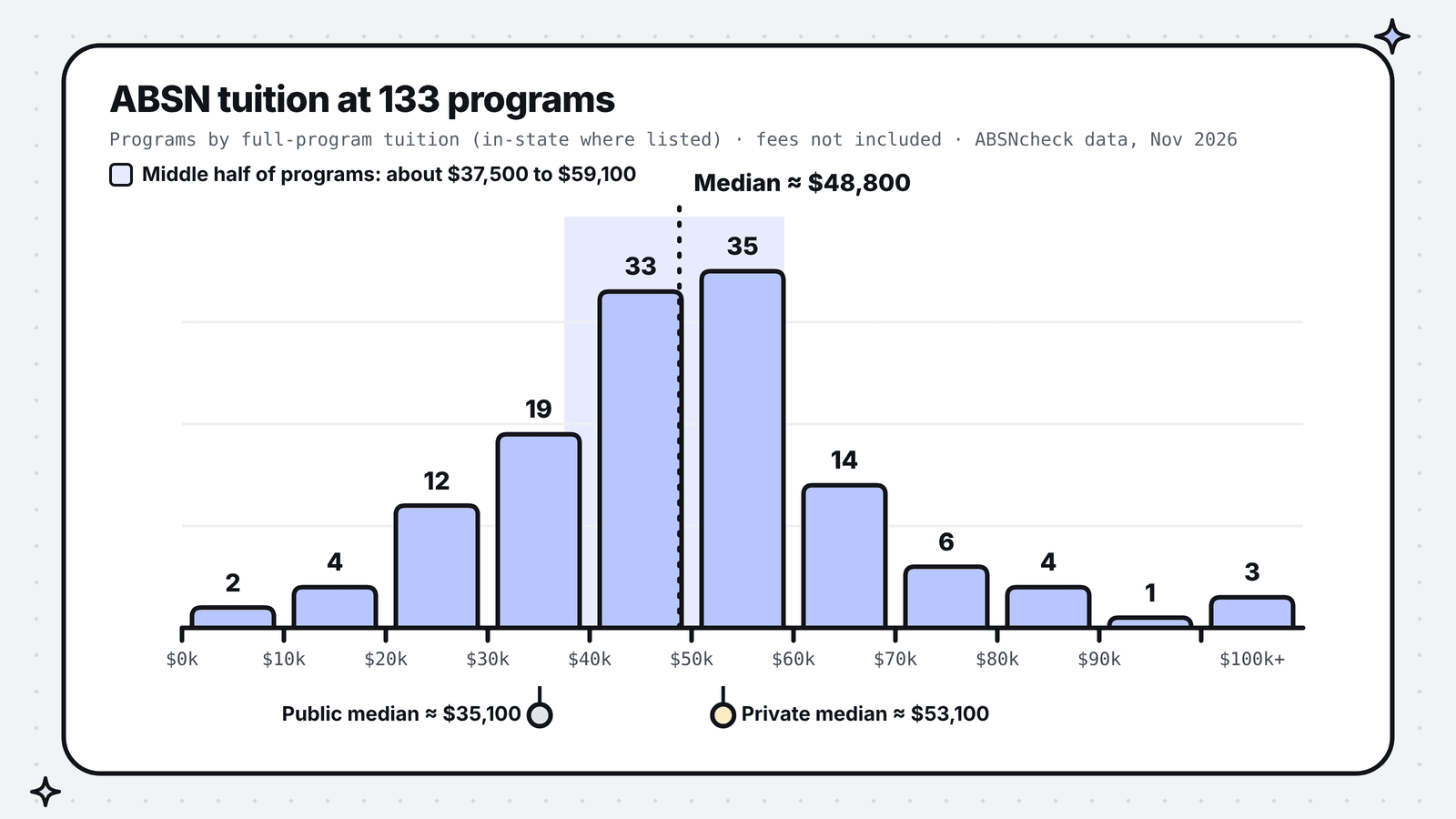
Across the 133 programs:
- Median tuition: about $48,800.
- The middle half of programs: about $37,500 to $59,100.
- Under $40,000: 37 programs.
- Over $60,000: 27 programs.
- The full range: from $7,783 (UNC Charlotte, in-state) to $109,200 (Samuel Merritt University, all-inclusive).
Program length explains part of the spread. A 12-month program with fewer credits often costs less than a 20-month one, even at similar per-credit rates.
Public vs. private ABSN programs
Whether a school is public or private matters more than almost anything else:
| Programs | Median tuition | Middle half | |
|---|---|---|---|
| Public universities | 38 | about $35,100 | about $22,400 to $42,700 |
| Private colleges and universities | 95 | about $53,100 | about $45,000 to $60,500 |
Public figures use the in-state rate where a school lists more than one.
At public schools, residency can double the price or more. George Mason University estimates about $23,600 for Virginia residents and about $65,000 for out-of-state students. The University of New Mexico estimates $36,441 for residents and $77,506 for non-residents. A few public programs charge everyone the same, such as the University of Massachusetts Amherst ($695 per credit) and the University of Wisconsin-Oshkosh ($50,338 total).
The lowest ABSN tuition we've found
This table ranks programs by tuition alone. Fees can change the order: a program with low tuition and high fees can cost more overall than one with higher tuition.
| Program | Tuition | Published fees | Notes |
|---|---|---|---|
| UNC Charlotte | $7,783 | $6,382 in university fees | In-state |
| Texas Tech University Health Sciences Center | $8,800 | $8,822 | Resident; cost-of-attendance estimate, 12-month program |
| University of Florida | about $12,800 | About $1,018 a semester for four semesters ($1,301.56 in the second), plus $700 to $860 before enrolling | In-state; our estimate ($212.74 per credit, 60 credits) |
| University of Central Florida | about $12,100 to $13,800 | About $634 in listed pre-enrollment costs (background check, drug screen, document tracker, lab kit, and uniforms) | In-state; $212.28 per credit for 57 to 65 credits. Fee total is our sum |
| UNC-Chapel Hill | about $14,600 | Not published | In-state; our estimate (two summers and one academic year) |
| Blue Mountain Christian University | $15,000 | $1,800 course material fee | Private; our estimate ($5,000 a semester, three semesters) |
| Arkansas State University | $20,234 | Not published | Published total |
| University of North Alabama | about $20,400 | "Plus additional fees"; amount not published | In-state; our estimate ($340 per credit, 60 credits) |
| Florida Atlantic University | $21,664 | Not listed separately | In-state; already includes books |
| Cleveland State University | $22,334 | $8,460 | In-state |
| West Liberty University | $22,408 | Already included in the tuition figure | Resident; published as one figure |
| University of Tennessee at Chattanooga | about $23,500 | $1,000 program fee each semester, plus $56 per credit for online or hybrid courses | In-state; our estimate (three semesters plus nursing differential) |
| George Mason University | about $23,600 | Not published | In-state estimate from the school |
| University at Buffalo | $24,000 | Not included; amount not published | Resident estimate from the school |
| University of South Alabama | about $27,000 | "Plus fees"; amount not published | In-state |
| Barry University | about $28,000 | $50 per credit each semester | Private; our estimate ($7,000 a semester, four semesters) |
| South Dakota State University | about $28,644 | Not published | Residents and some neighboring states |
| Saint Peter's University | $28,800 | $3,300 to $4,000 | Private; published total |
Tuition as published in November 2026. "Not published" means our directory has no fee figure for that program, not that the school charges no fees. Low-cost public programs are often the most competitive to get into, and many give priority to state residents.
How fees change the ranking
Add each school's published fees, and the order shifts:
- UNC Charlotte: $7,783 in tuition, about $14,200 with university fees.
- Texas Tech University Health Sciences Center: $8,800 in tuition, about $17,600 with fees.
- University of Florida: about $12,800 in tuition, about $17,800 with fees.
- Cleveland State University: $22,334 in tuition, about $30,800 with fees.
Texas Tech's tuition is about $4,000 lower than Florida's, but once fees are counted, the two cost almost the same. That's why it pays to compare tuition plus fees, not tuition alone.
Want the full list? Browse every ABSN program: each program page shows its published tuition with a link to the source.
Programs where an employer pays
A few programs partner with hospitals that cover some or all of the cost in exchange for a work commitment:
- University of Louisiana at Lafayette and Ochsner Health: Ochsner covers tuition for the nursing courses, and graduates commit to work for Ochsner for three years. Students pay for their own prerequisites.
- University of Alabama in Huntsville: tuition is paid by an employer partner through a "Last Dollar" scholarship.
- Research College of Nursing: tuition and fees of $49,670 drop to $19,295 with HCA's work loan forgiveness.
Read the work commitment carefully, including what happens if you leave early.
Costs beyond tuition
Some programs with low tuition charge high fees, so the total can come close to double the tuition figure. Texas Tech, in the table above, is one example. Check fees before you compare programs on price.
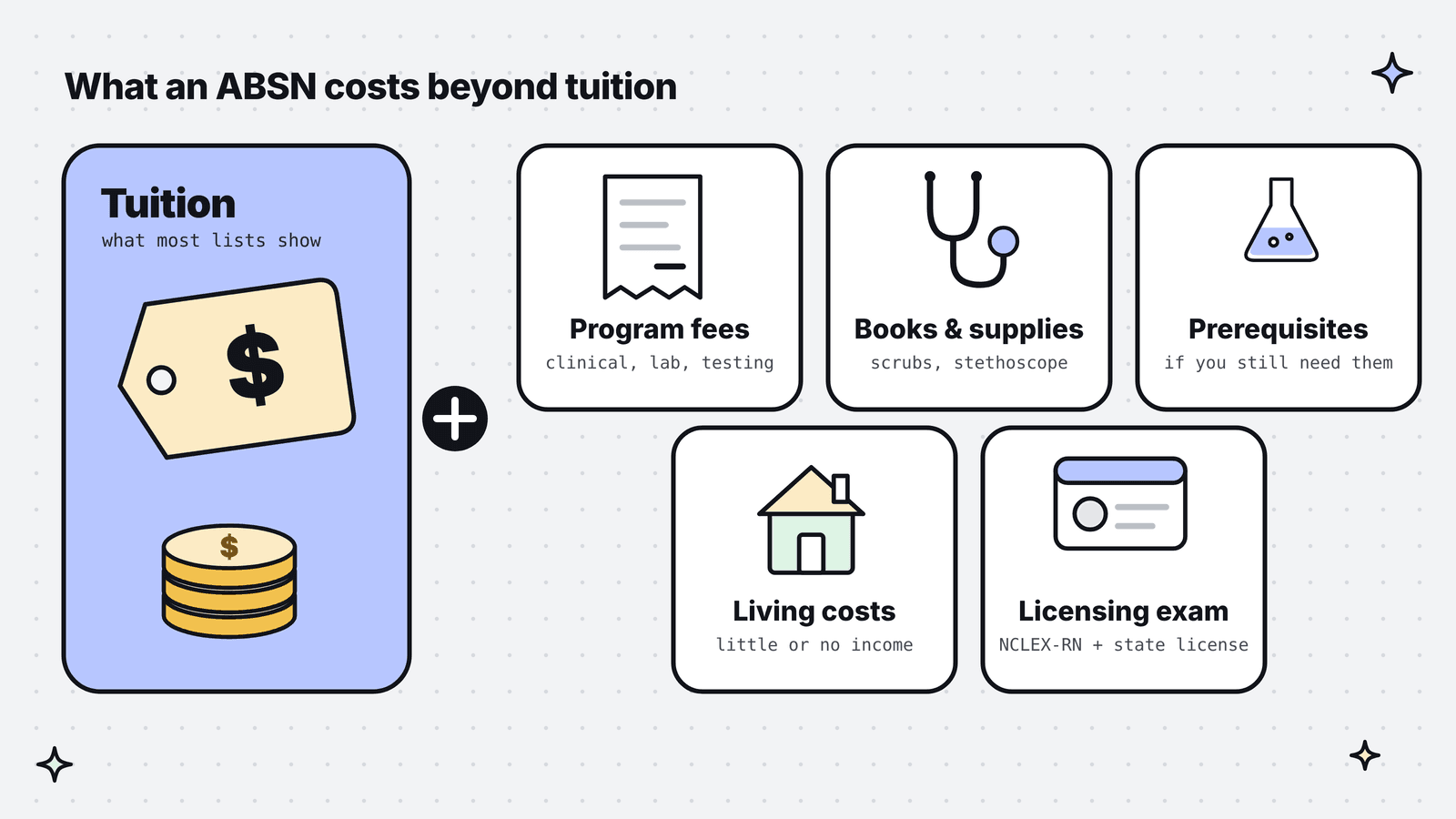
Budget for:
- Program fees. Many schools add fees for clinicals, labs, testing, and software. The College of Saint Scholastica lists about $4,200 in added fees; Harding University adds $5,100 in nursing fees and $2,400 in technology fees; and Lipscomb University charges $3,500 per semester in ABSN fees.
- Books, uniforms, and supplies, including scrubs, a stethoscope, and exam-prep subscriptions.
- Prerequisites. If you still need science courses, they add cost before the program starts. See our nursing prerequisites guide.
- Living costs. The American Association of Colleges of Nursing (AACN) notes that ABSN students are encouraged not to work, so plan for 12 to 18 months with little or no income.
- The licensing exam. After graduating, you'll pay to register for the National Council Licensure Examination for Registered Nurses (NCLEX-RN) and apply for your state license.
Is an ABSN worth the cost?
For many career changers, yes. Registered nurses earned a median salary of $97,550 in May 2025, according to the U.S. Bureau of Labor Statistics, and an ABSN is the fastest way to become one if you already have a bachelor's degree.
But the price range is wide. Tuition for the same degree runs from under $10,000 at one school to over $100,000 at another, so the program you choose matters as much as the decision to go. If cost is your biggest concern, compare it with the associate degree in nursing (ADN) route in our ADN vs BSN guide.
Check the programs you can afford
The cheapest program only helps if you meet its prerequisites. ABSNcheck compares your courses with each program's published requirements, so you can see where you stand at affordable programs and what's missing. Typing in your courses is free, and so is the result for one program.
Frequently asked questions
How much does an ABSN cost on average?
The median tuition across 133 programs was about $48,800, with the middle half between about $37,500 and $59,100. Fees, books, and living costs are extra.
What is the cheapest ABSN program?
The lowest tuition we've found is at UNC Charlotte ($7,783 for North Carolina residents), followed by Texas Tech University Health Sciences Center ($8,800 for Texas residents). Fees can change which program is cheapest overall, so compare tuition plus fees, and confirm current prices with each school.
Are public ABSN programs cheaper?
Usually. The public median was about $35,100 at in-state rates, compared with about $53,100 at private schools. Out-of-state students often pay close to private prices.
Can you get financial aid for an ABSN?
Often, yes. Students with a bachelor's degree can usually borrow federal student loans, and many schools, hospitals, and nursing organizations offer scholarships or tuition help. Most federal grants, like the Pell Grant, generally aren't available for a second bachelor's degree. Choosing a public school in your own state is often the single biggest saving.
Is an ABSN more expensive than an ADN?
Usually. Associate degree in nursing (ADN) programs at community colleges typically cost much less, but take longer for someone who already has a bachelor's degree. See our ADN vs BSN guide for the full comparison.