Online ABSN programs: how hybrid accelerated nursing programs work
In this article7 sections
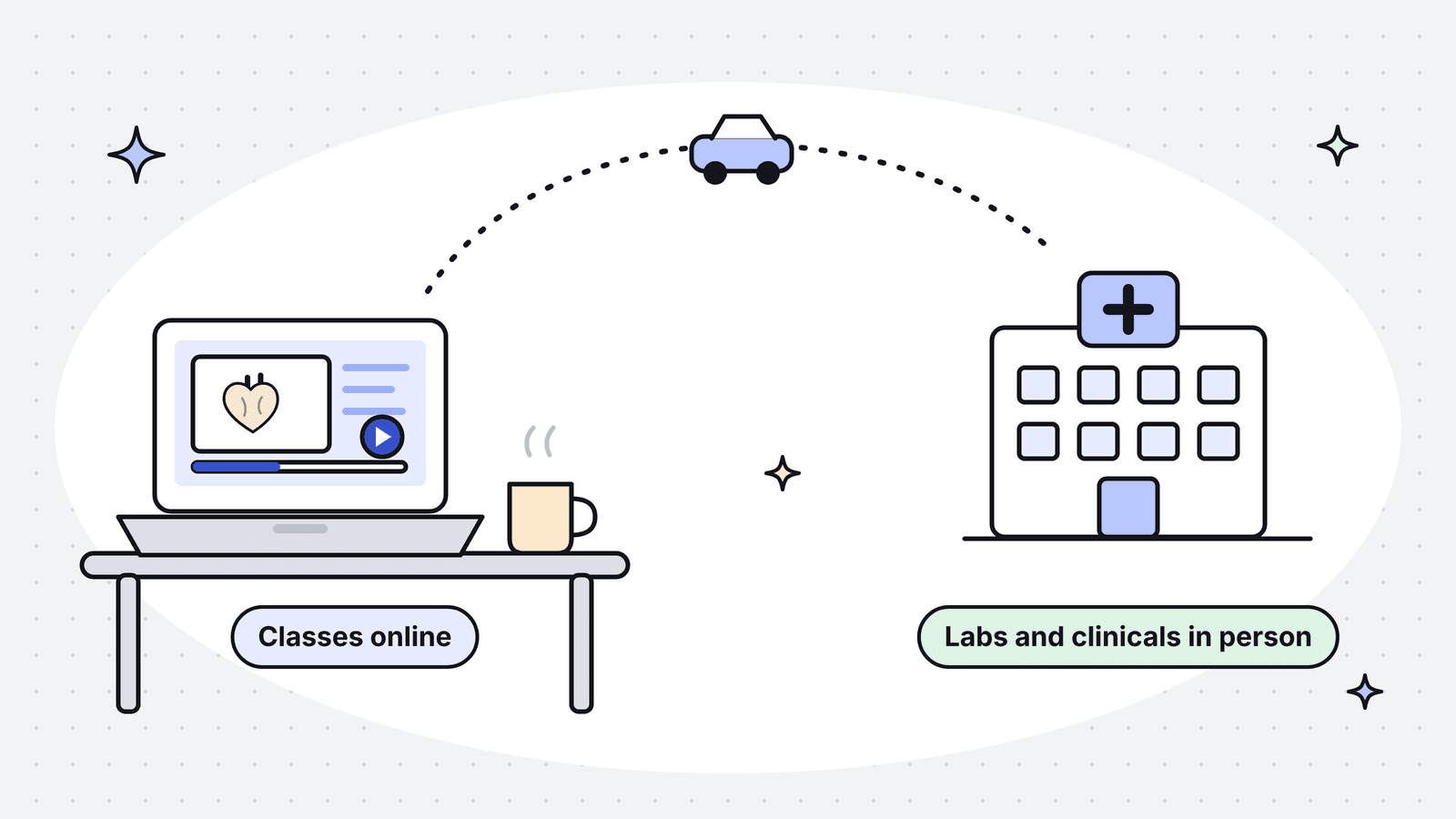
You can't do an accelerated Bachelor of Science in Nursing (ABSN) fully online: in every program we've checked, labs and clinical rotations happen in person. What schools call an "online ABSN" is a hybrid: nursing classes online, with skills labs, simulation, and clinicals at a campus or nearby healthcare sites. Of the 274 ABSN programs in our directory with a published format, 71 describe a hybrid option.
That still leaves real choices. Some hybrid programs keep you near campus several days a week; others let you do clinicals near home and visit campus only a few times. Here's how they work and what to ask before you apply.
Why an ABSN can't be fully online
Nursing school prepares you for a licensing exam, the National Council Licensure Examination for Registered Nurses (NCLEX-RN), and it does that through supervised hands-on practice. You learn skills on mannequins and classmates in a lab, then care for real patients during clinical rotations at hospitals and clinics.
Simulation can cover part of that. A National Council of State Boards of Nursing (NCSBN) study found that up to 50% simulation can be substituted for traditional clinical experience. But simulation happens in a lab, too, and none of the 274 programs in our directory with a published format offers clinical rotations online.
What's online and what isn't
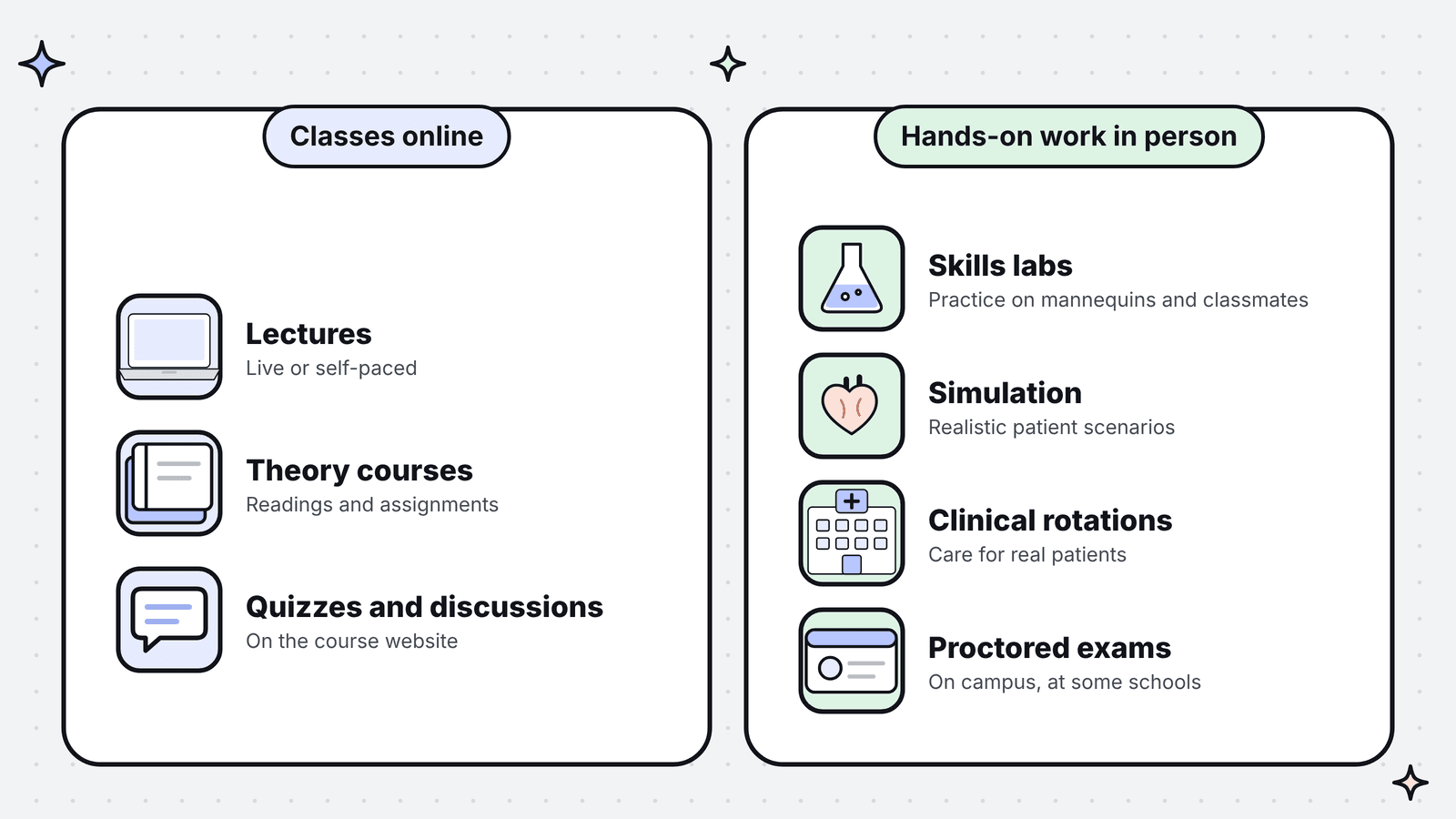
In a typical hybrid ABSN:
- Online: lectures and theory courses, either live on a schedule or self-paced within weekly deadlines.
- In person: skills labs, simulation, clinical rotations, and at some schools, proctored exams. The University of Massachusetts Dartmouth, for example, runs lectures fully online but holds labs, proctored exams, and clinical practice in person.
Three kinds of hybrid ABSN
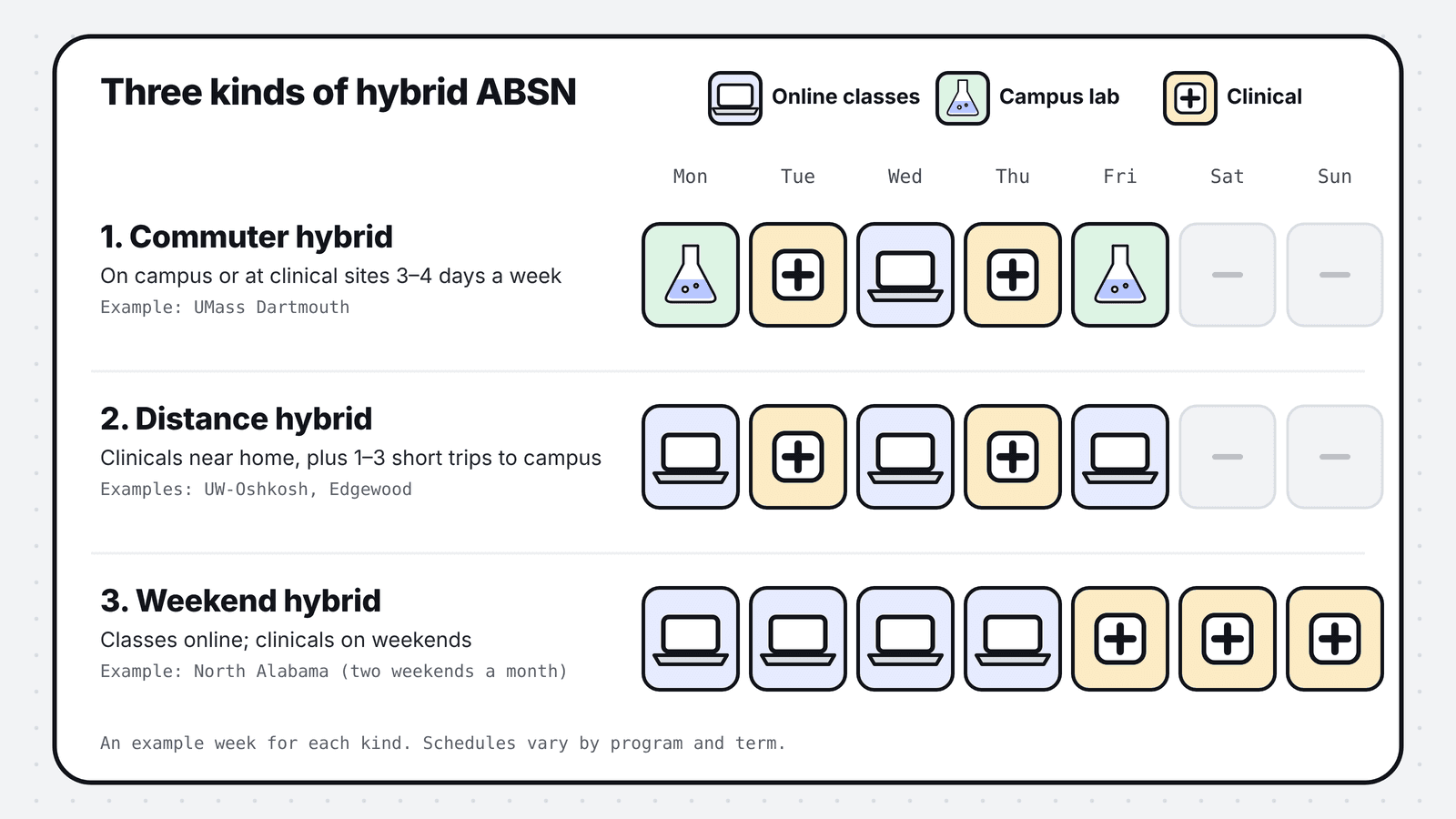
"Hybrid" covers very different schedules. The programs in our directory show three patterns:
1. Commuter hybrid. Classes are online, but labs and clinicals keep you near campus several days a week. UMass Dartmouth tells students to expect to be on campus or at clinical sites three to four days a week. At Assumption University, students spend one to two days a week on campus and travel to clinical sites about two days a week.
2. Distance hybrid with campus visits. You do clinicals near home and travel to campus a few times for intensive lab sessions, often called residencies or immersions. The University of Wisconsin-Oshkosh offers theory courses 100% online, clinical rotations in or near your home community, and one two-week residency on campus. Edgewood University has three lab immersions in Madison, Wisconsin. At Texas Tech University Health Sciences Center, classes are online, and clinicals are guided by clinical coaches in the student's own community, in places that include Dallas, Lubbock, and the Austin-Hill Country area.
3. Weekend hybrid. Classes are online, and in-person work is grouped into weekends. At the University of North Alabama, clinicals run two weekends a month, Friday through Sunday.
Labels vary, so read the details. Herzing University pairs online general education classes with on-campus nursing classes, and the University of North Georgia's hybrid format has at least half of course time in person.
The catches
It's still full time. A hybrid ABSN moves as fast as an in-person one: 54 of the 64 hybrid programs with a published length run 12 to 16 months. Saint Joseph's College of Maine tells students to expect 48 to 60 hours a week in total.
Where you live matters. Some hybrid programs only work if you live near a campus or clinical partner:
- Idaho State University requires students to live within daily commuting distance of their campus.
- Indiana State University doesn't require Indiana residency, but all clinicals must be completed in Indiana.
- The University of Providence holds skills labs and clinical immersions at its locations in Montana and Alaska.
Federal rules add another limit. Since July 1, 2024, a college that takes federal student aid must make sure a program leading to a license meets the educational requirements of each state where its distance education students are located. If a school can't confirm that for your state, it may not enroll you.
Clinical placements vary. Ask who arranges them and how far you might travel. Edgewood, for example, notes that travel may be required based on site availability.
Questions to ask before you apply
- Which courses are online, and are they live or self-paced?
- How many days a week will I be on campus or at clinical sites?
- How many campus visits are there, and how long is each one?
- Who arranges my clinical placements, and how far might I travel?
- Does the program accept students who live in my state?
Check your prerequisites first
A hybrid format can open up programs far from home, and each one sets its own prerequisite courses, grades, and time limits. ABSNcheck compares your courses with each program's prerequisites and shows what's missing. Typing in your courses is free, and so is the result for one program.
New to accelerated programs? Start with What is an ABSN program? or see what an ABSN costs.
Frequently asked questions
Can you do an ABSN fully online?
No. Classes can be online, but in every program we've checked, skills labs, simulation, and clinical rotations happen in person. Hybrid programs put the coursework online and schedule the hands-on work at a campus or at clinical sites.
Are there online nursing programs for non-nurses?
Yes, in hybrid form. A hybrid ABSN is designed for people with a bachelor's degree in another field: the nursing coursework is online, and labs and clinicals are in person. Online programs for people who are already registered nurses (RNs), such as degree-completion programs, are a different thing.
How many ABSN programs are hybrid?
Of the 274 ABSN programs in our directory with a published format, 71 describe a hybrid option, in 36 states. Thirteen of those also offer an on-campus track. Another 24 don't say enough about their format to tell.
Can you work during a hybrid ABSN?
It's hard. Hybrid programs move at the same pace as in-person ones, and the American Association of Colleges of Nursing (AACN) notes that students in accelerated programs are encouraged not to work.
Is a hybrid ABSN as good as an in-person one?
Both lead to the same degree and the same licensing exam, the NCLEX-RN. Choose based on schedule, clinical placements, and where you live.