ADN vs BSN: which nursing degree should career changers choose?
In this article8 sections
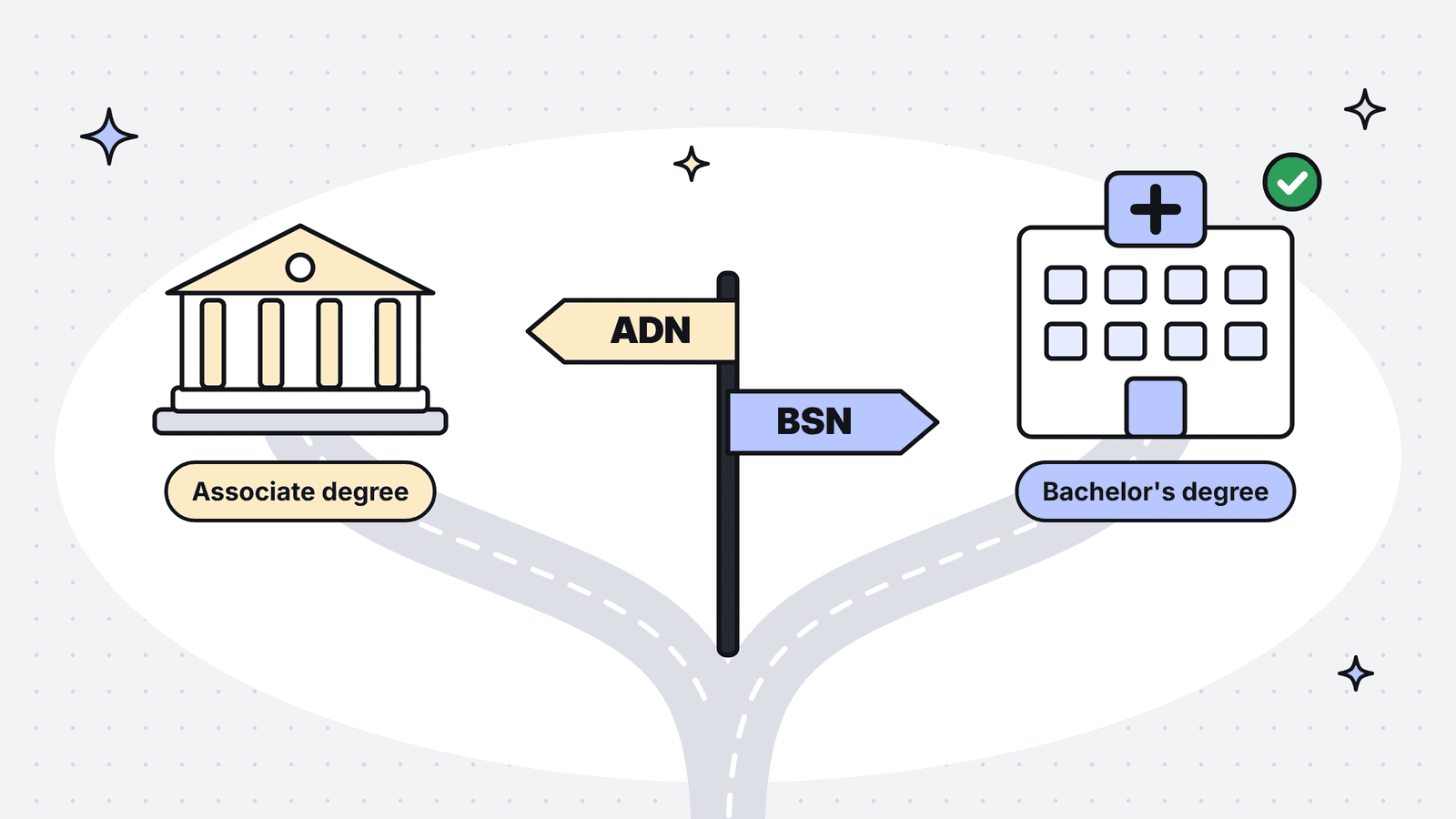
An associate degree in nursing (ADN) and a Bachelor of Science in Nursing (BSN) both lead to the same licensing exam, the National Council Licensure Examination for Registered Nurses (NCLEX-RN), and the same registered nurse (RN) license. A BSN opens more hospital jobs and leadership roles; an ADN usually costs less. If you already have a bachelor's degree, the real choice is between an ADN and an accelerated BSN (ABSN).
Many ADN vs BSN guides are written for students starting from scratch. This one is for career changers, who face a different trade-off.
ADN vs BSN at a glance
| ADN | BSN | |
|---|---|---|
| Where it's offered | Mostly community colleges | Universities (or an ABSN if you have a bachelor's) |
| Licensing exam | NCLEX-RN | NCLEX-RN |
| Cost | Usually lower | Usually higher |
| Hospital hiring | Not accepted by every employer | Required by some employers, strongly preferred by most |
| Leadership and graduate school | Usually requires a BSN first | Ready to go |
Do you need a BSN to be an RN?
No. ADN graduates take the same licensing exam and hold the same RN license as BSN graduates.
But the license isn't the whole story. In its 2023 survey of nursing schools, the American Association of Colleges of Nursing (AACN) found that 25% of hospitals and other healthcare settings required new hires to have a bachelor's degree in nursing, and 69.8% of employers strongly preferred BSN graduates. The Bureau of Labor Statistics (BLS) notes the same pattern: graduates of any program type qualify for entry-level staff nurse positions, but employers, "particularly those in hospitals," may require a bachelor's degree.
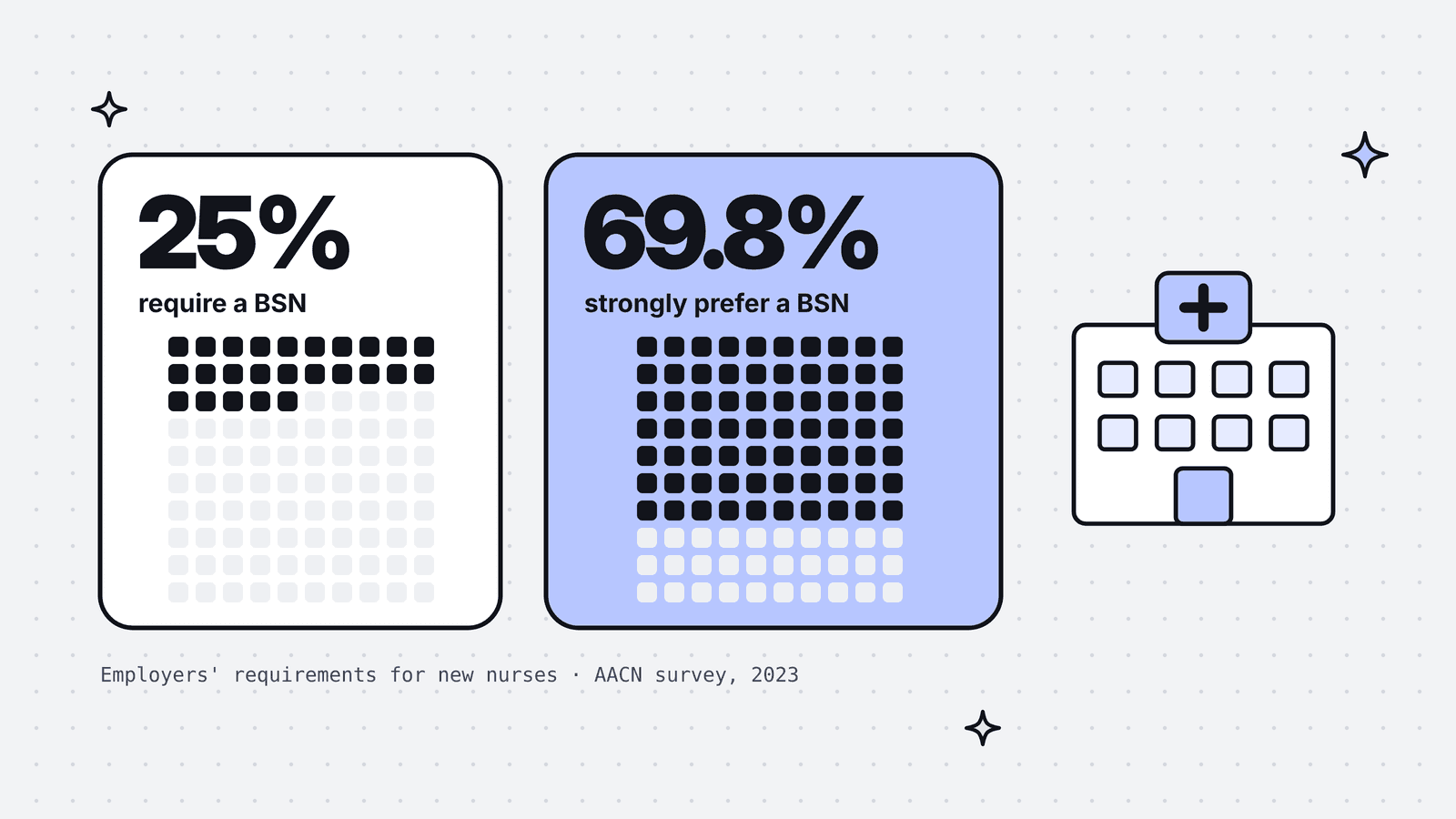
In practice, an ADN can still get you hired: three in four employers in that survey did not require a BSN. A BSN gives you more choices, particularly at hospitals.
ADN vs BSN salary
The BLS reports a median annual wage of $97,550 for registered nurses (May 2025) but doesn't break pay down by degree, so there is no official ADN versus BSN figure. Where starting pay differs, each employer sets the difference.
The bigger gap comes later. The BLS says a bachelor's or higher degree is often necessary for administrative positions, research, consulting, and teaching, and advanced practice roles such as nurse practitioner need a master's degree. So a BSN tends to pay off over a career rather than on day one.
If you already have a bachelor's degree: ADN or ABSN?
This is the decision most career changers actually face. There are two realistic routes:
Route 1: ADN, then RN-to-BSN. Earn an associate degree, start working as an RN, then complete an RN-to-BSN program, often online and often while working.
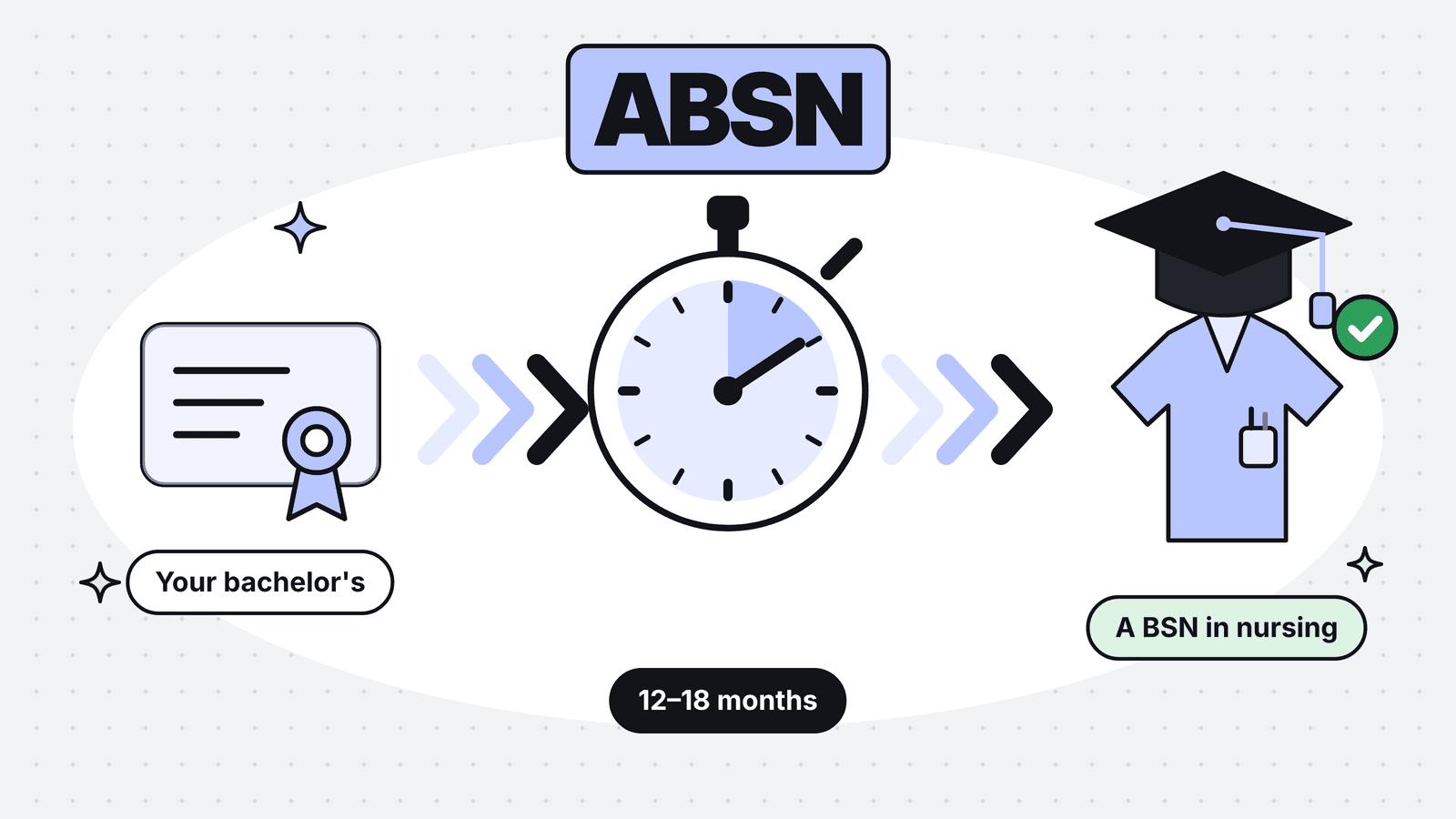
Route 2: Accelerated BSN (ABSN). Use your existing bachelor's degree to earn a BSN in 12 to 18 months, according to AACN.
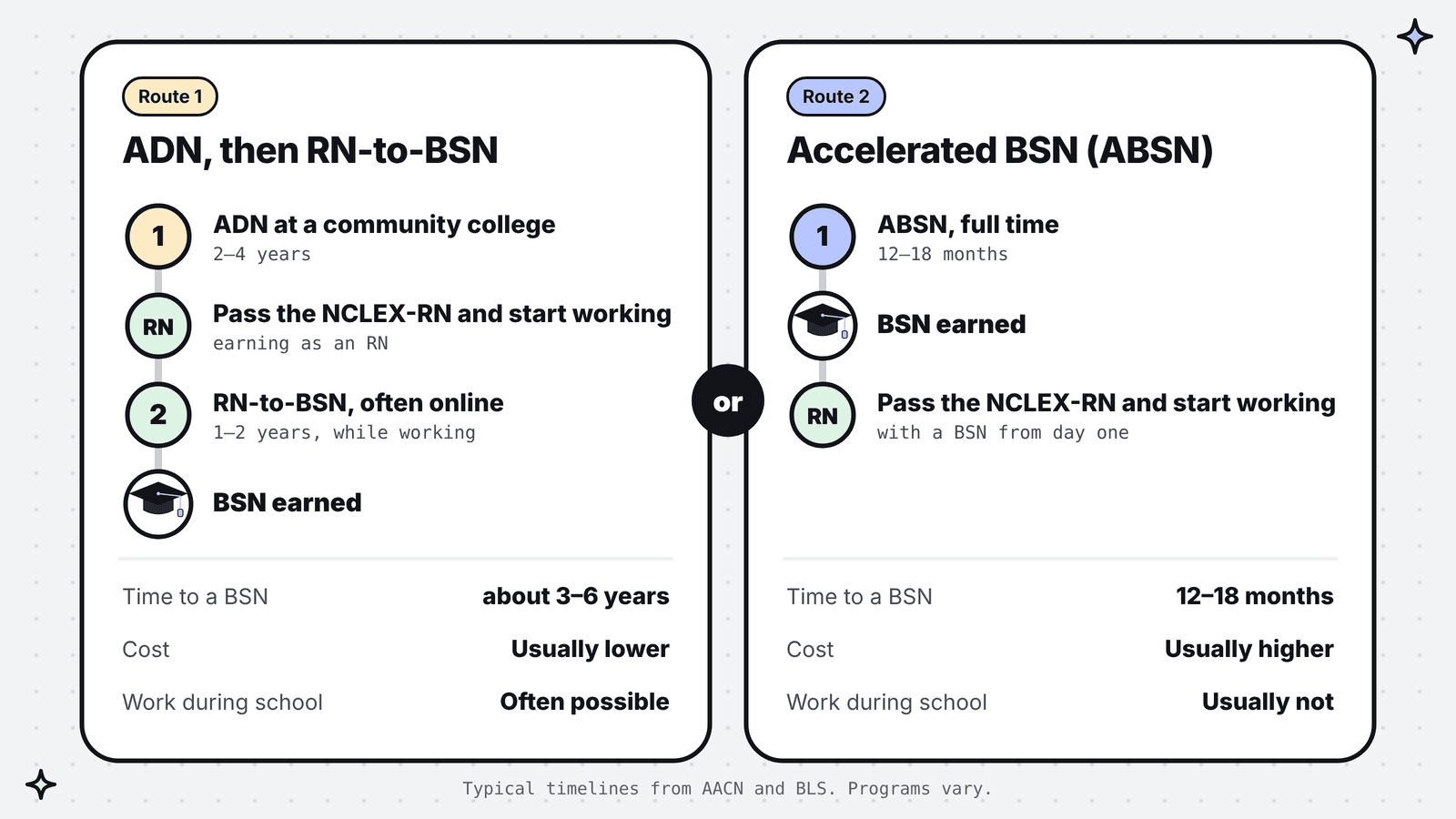
Here's how they compare:
Time. An ABSN takes 12 to 18 months, a range AACN says includes prerequisites. ADNs are often described as two-year degrees, but the BLS says they typically take four years to complete. Admission can be competitive, and some community colleges have waitlists. Add 1 to 2 years for an RN-to-BSN program if you want the bachelor's later.
Cost. An ADN at a community college usually costs less than an ABSN, especially one at a private university. An RN-to-BSN program adds cost later, though the BLS notes that some employers offer tuition reimbursement.
Income. The ADN route can leave room to work part-time during school. ABSNs are full time and intense; AACN says students are encouraged not to work.
Flexibility. RN-to-BSN programs are widely available: AACN counts 701 of them, more than 600 offered at least partly online. That makes finishing the BSN later realistic.
Is an ABSN worth the debt?
It depends on what the extra speed is worth to you. A simple way to think about it:
- Estimate the cost difference between the ADN route (including an RN-to-BSN program later) and the ABSN.
- Estimate the time difference before you're working as an RN at the kind of employer you want.
- Multiply the time saved by a nurse's salary. If you'd start working several months to a year sooner with an ABSN, that income can cover much of the price gap.
Where the math breaks down: very expensive private ABSNs, large loans at high interest, or a local job market where ADN nurses are hired readily. In those cases, the ADN route can be the smarter move.
Which should you choose?
Choose an ADN if:
- Keeping costs low matters more than speed.
- Your local hospitals hire ADN nurses.
- You need to keep working part-time.
- A community college near you has open seats, not a long waitlist.
Choose an ABSN if:
- You want to work at a large hospital or one that requires a BSN.
- You want to start your nursing career as soon as possible.
- You can study full time for 12 to 18 months.
- You plan to pursue leadership roles or graduate school later.
Both routes start with the same step
Whichever path you choose, you'll need core science prerequisites such as Anatomy & Physiology, Microbiology, and Chemistry. Each school sets its own list, and many set time limits and minimum grades, so courses you took years ago may no longer count.
ABSNcheck compares your courses with each ABSN program's prerequisites and shows which you've met, what's missing, and what's about to expire, so you can compare routes with real numbers. It's free for your first three programs.
Related: Nursing prerequisites: the complete list · What is an ABSN program? · Nursing as a second career
Frequently asked questions
Is an ADN or BSN better?
Neither is better for passing the NCLEX-RN, since graduates of both take the same exam. A BSN is better for hospital hiring, leadership, and graduate school. An ADN is better if cost and flexibility matter most.
Do ADN and BSN nurses get paid the same?
There is no official figure: the BLS reports one median wage for registered nurses and doesn't split it by degree. Over a career, a BSN gives access to roles that usually need one, such as administration and teaching.
How long does it take to go from ADN to BSN?
RN-to-BSN programs take 1 to 2 years, according to AACN, and more than 600 of them are offered at least partly online.
Can I get an ADN if I already have a bachelor's degree?
Yes. Your general education credits may transfer, but you'll still need to complete the nursing coursework and any missing science prerequisites.
Is an ABSN worth it?
For career changers who can study full time, it's the fastest way to a BSN. It's worth comparing the total cost and time against the ADN route first, especially if your local hospitals hire ADN nurses.